As an Amazon Associate, we earn a small commission from qualifying purchases — at no extra cost to you.
Confused by terms? Not a problem. Learn about the Most Common Crochet Stitch Techniques with simple explanations for every skill level!
Whether you’re picking up a hook for the first time or brushing up before starting a new project. This guide walks through the essential stitches every crocheter relies on. Create beautiful crochet projects by understanding every stitch with ease.
Most Common Crochet Stitch Techniques
1. Slip Knot
The adjustable loop used to attach the yarn to the hook. It is the starting point of almost every crochet project, although it does not actually count as a stitch in the tutorials.
2. Chain (ch)

Most flat crochet projects use a chain stitch as the starting line. Placed at the end of each row to create space for the hook before starting the next row. Most ideal for mesh or lace patterns.
3. Magic Ring (mr)

Magic ring is also known as the magic circle in some tutorials. It is also an adjustable ring that creates a tightly closed center. Perfect for projects worked in rounds, like amigurumi toys or granny squares.
4. Slip Stitch (sl st)

The shortest and simplest crochet stitch is the sl st. It is mainly used to join the rounds, move the yarn, or create neat edges without adding extra height.
5. Single Crochet (sc)

This is usually the very first actual stitch taught to new crocheters after the chain. It is a short and basic stitch technique, ideally used for amigurumi, dishcloths, bags, and more. Also, you will find the sc stitch only applicable in US terminology, so it will be easier to identify.
6. Double Crochet (dc)

Remember! The dc stitch has the same name in both US and UK terminologies, but actually means two different things. It is a tall stitch that works up projects like shawls, blankets, and sweaters more quickly.
7. Half Double Crochet (hdc)

As the name suggests, the hdc stitch is taller than the sc, but shorter than the dc. If you are working on garments such as soft blankets, hats, or scarves, you can use the hdc to speed up the process.
8. Treble Crochet (tr)

One of the tallest basic stitches, it is also known as a triple crochet in the US terminology. This technique is often used in lacey patterns or other decorative designs because it produces a light and breathable texture.
9. Double Treble Crochet (dtr)

An even taller stitch than the tr, and very similar. Used for lace and decorative designs as well. Commonly used in lace patterns, decorative motifs, and textured designs where added height is needed.
10. Front Post Double Crochet (FPDC)

The front post double crochet (FPDC) is a variation of the standard double crochet. Instead of working into the top loops of the stitch, you insert the hook around the post of the stitch from the front. This technique creates raised, textured ridges and is often used for ribbing, cables, and other textured crochet patterns.
11. Back Post Double Crochet (BPDC)

Similar to FPDC, but worked around the back of a stitch, as the name suggests. Alternating between the FPDC and BPDC can create a stretchy texture for making sweaters, cuffs, or hats.
12. Puff Stitch

The puff stitch is mainly used as a decorative technique by creating tall loops multiple times in the same stitch, and then joining them together. This will give your project a soft, ‘puffy’ texture.
13. Bobble Stitch

When several unfinished double crochets are worked into the same stitch and completed together, it forms a bobble stitch. So, if you are creating any 3D shapes, blankets, pillows, or toys where you need a thick texture, you will see the designer has used a bobble stitch.
14. Popcorn Stitch

Where a bobble technique requires multiple unfinished dc stitches, a popcorn stitch is created by working on several complete dc stitches into one and then joining them all together. As a result, a rounded, 3D texture is formed.
15. Shell Stitch
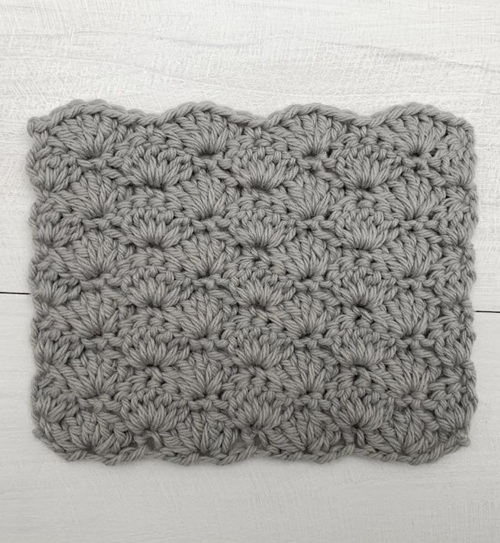
The shell stitch may look fancy, but it only uses the most basic beginner stitches. By crocheting multiple stitches into the same place, you will create a fan-like structure. You can then use this shell stitch to decorate any project that you want to make.
16. Picot Stitch

A small loop created with a few chain stitches and joined back into the same stitch. It is great for decorating the edges of blankets, table mats, coasters, or any garments.
17. Waffle Stitch

This stitch looks exactly like the name suggests: like a waffle. It mainly uses dc and fpdc techniques to create a grid or honeycomb texture…or a breakfast waffle!
Skill Levels for Every Popular Stitch
Not sure which crochet stitches to learn first? This crochet stitch chart organizes the most popular stitches by skill level, making it easy to see which techniques are best for beginners and which ones are worth tackling as your skills grow. Use this quick reference to plan your crochet journey and confidently choose stitches for your next project.
| Stitch | Skill Level |
|---|---|
| Slip Knot | Beginner |
| Chain (ch) | Beginner |
| Magic Ring (MR) | Beginner |
| Slip Stitch (sl st) | Beginner |
| Single Crochet (sc) | Beginner |
| Double Crochet (dc) | Beginner |
| Half Double Crochet (hdc) | Beginner |
| Treble Crochet (tr) | Beginner–Intermediate |
| Double Treble Crochet (dtr) | Intermediate |
| Front Post Double Crochet (FPDC) | Intermediate |
| Back Post Double Crochet (BPDC) | Intermediate |
| Puff Stitch | Intermediate |
| Bobble Stitch | Intermediate |
| Popcorn Stitch | Intermediate |
| Shell Stitch | Intermediate |
| Picot Stitch | Beginner–Intermediate |
| Waffle Stitch | Advanced-Intermediate |
The list may look like a lot. But don’t worry about memorizing every stitch at once. With continuous practice and some confidence, these techniques will eventually come naturally to you. These are just the beginning, or the basic fundamentals of crochet. There are countless more stitches and techniques that you will explore as you keep going. Once you have mastered and experimented with them all, you will find your own unique style!
Are you ready to be a pro?


